SpaceX’s Starship test comes as shares hover near IPO price
The company’s giant rocket is due for another test flight as analysts tie its future growth to Starship’s payload power and reusability.
By Frankie Delgado · News Reporter
3 min read
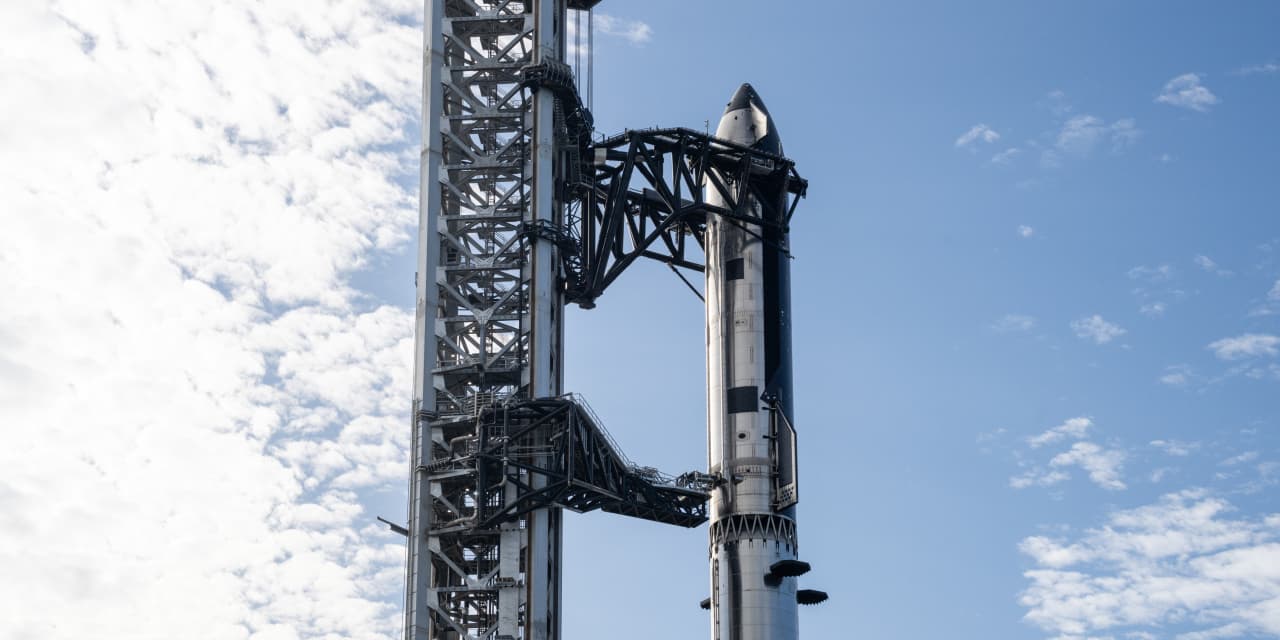
SpaceX’s biggest rocket is due back in the sky Thursday night, and investors have plenty riding on the climb.
The company’s Starship system, paired with its Super Heavy booster, is scheduled for another test flight from Starbase in Boca Chica Beach, Texas, according to MarketWatch. The launch window opens at about 6:45 p.m. Eastern time.
The flight is the second test of the third-generation Starship and Super Heavy setup, which previously flew in May. MarketWatch reported that earlier test was largely successful, though it also ran into problems seen in prior Starship flights.
A key test for Starship
SpaceX plans to use a changed engine-start sequence and other updates aimed at reducing problems with the Super Heavy booster, according to information cited by MarketWatch from the Federal Aviation Administration.
The upper stage of Starship is also set to deploy 20 Starlink V3 satellites in a test. Those satellites, described as bigger and more capable than earlier versions, are expected to burn up during re-entry about 20 minutes after deployment.
Six of the satellites will carry cameras to inspect Starship’s heat shield, giving SpaceX data on how the system performs in harsh flight conditions. The previous test used 20 Starlink simulators and two modified satellites that took images of Starship while it was in space.
Chad Anderson, managing partner at Space Capital, which first backed SpaceX in 2017, told MarketWatch he felt positive about the test and said the company had reduced much of the risk around major engineering hurdles.
Why Wall Street is watching
The flight is Starship’s 13th overall test. SpaceX has said in its prospectus that Starship could begin launching Starlink V3 satellites in the second half of 2026, a step that could strengthen the company’s satellite-internet business.
Analysts cited by MarketWatch see Starship as central to SpaceX’s future. Mizuho’s Brett Linzey called it the most important item to watch for the company.
Clear Street Research analyst Brian Dobson wrote in a client note that SpaceX’s plans for Starlink V3, orbital AI computing and lunar missions depend heavily on Starship’s payload capacity and reusability. Dobson said major delays or reliability problems would hurt the growth assumptions in his model.
SpaceX has spent more than $15 billion developing Starship and expects to spend more this year, according to a company filing. The filing said research-and-development costs in the space segment are expected to rise as SpaceX invests in Starship, then ease after the vehicle is commercialized.
Some customers have already lined up Starship missions. Voyager Technologies has disclosed a $90 million agreement for Starship launch services tied to its Starlab space station. By comparison, SpaceX lists the price of its Falcon 9 rocket at $74 million.
JPMorgan analysts said Starship V3 could deliver 10 times the cost improvement and four times the payload capacity of Falcon 9. SpaceX has said Starship could eventually cut the cost of reaching orbit by 99% compared with the historic average of $18,500 per kilogram.
Shares under pressure
The test comes as SpaceX’s stock has been volatile since its June 12 public debut, according to MarketWatch. Shares closed at a new low Wednesday after falling as far as $132.15 in intraday trading, dropping below the $135 IPO price for the first time, before ending at $135.27.
On Thursday afternoon, the stock was down a little more than 1%, trading around $133.
SpaceX also has another mission scheduled Thursday: a Falcon 9 launch carrying a payload for the U.S. Space Development Agency’s Proliferated Warfighter Space Architecture, according to the company.
This story draws on original reporting from MarketWatch.