Wildfire smoke puts Midwest and Northeast under air quality alerts
Smoke from fires in Canada and Minnesota has pushed unhealthy air into major U.S. cities, with alerts stretching from the Midwest to New England.
By Sal Moretti · Money Reporter
3 min read
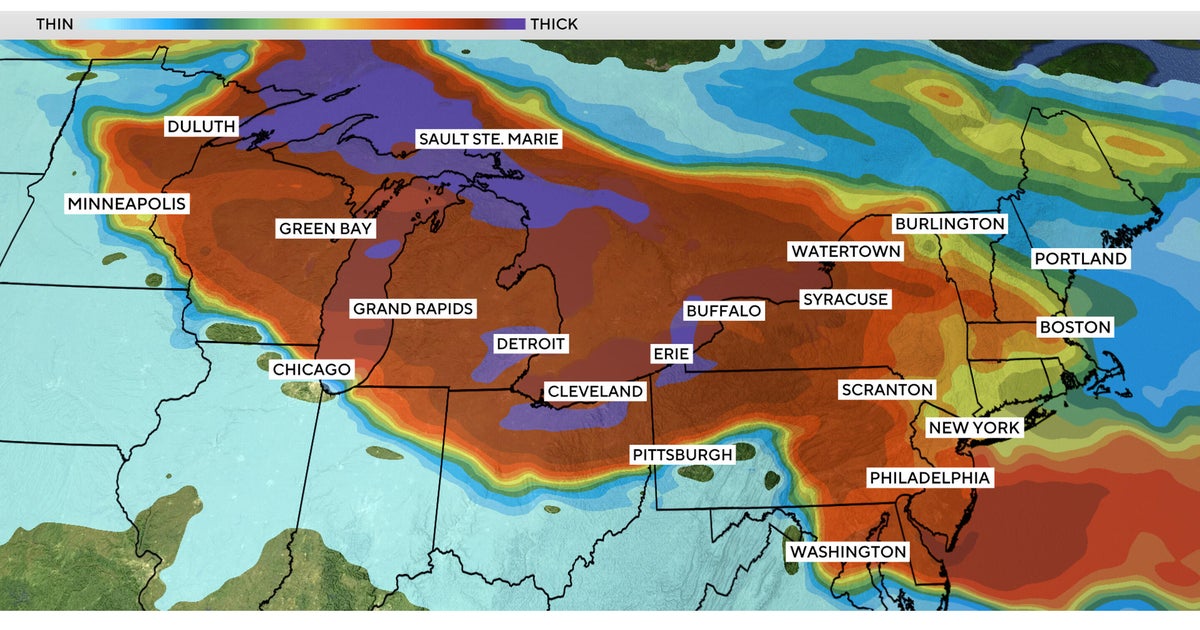
Smoke from more than 100 Canadian wildfires, plus fires burning in northern Minnesota, has pushed dangerous air into parts of the Midwest and Northeast this week, according to CBS News and state officials.
Winds are carrying the smoke southeast, exposing millions of people to fine particle pollution. Health officials say that kind of pollution can be especially risky for children, people with heart or lung disease, and other sensitive groups.
Detroit, Minneapolis and Chicago were listed Thursday among the five most polluted major cities in the world by IQAir, CBS News reported. Air quality alerts reached from Minnesota through parts of the Northeast.
Alerts stretch across states
Minnesota officials issued an air quality alert through Friday for areas including the Twin Cities metro. The state’s northeastern corner was expected to see very heavy smoke, and air quality there reached hazardous levels, CBS News reported, meaning the air was considered unsafe for everyone.
Michigan officials placed the entire state under an air quality alert Thursday, with CBS News Detroit reporting that the alert could be extended if conditions require it. Wisconsin officials also warned residents that poor air could continue for days.
New York state had an air quality advisory in effect Thursday. Officials said N95-style masks would be handed out to commuters in New York City, according to CBS News New York.
In Pennsylvania, the Department of Environmental Protection declared a Code Red air quality alert for Thursday, saying wildfire smoke had created unhealthy pollution levels for the general public. Massachusetts environmental officials issued a statewide air quality alert.
CBS News Boston reported that smoke moved into the Boston area, turning skies from pale white to brownish yellow. “It almost felt like you were at a campsite with an active fire going,” West Roxbury resident James Venezia told the station.
The haze also reached Vermont, New Hampshire and Maine, CBS News reported.
Smoke forecast and health advice
Tyler Hasenstein, a meteorologist with the National Weather Service in Chanhassen, Minnesota, told CBS News that the thickest smoke could reach as far south as Washington, D.C., by midday Thursday.
Hasenstein said people should remain indoors as much as they can because smoke and extreme heat were arriving together. “Those two things coinciding with each other is not good from a health perspective,” he said.
Experts cited by CBS News said wildfire smoke can bring shortness of breath, coughing, dizziness and fatigue, and can worsen heart and lung disease and other chronic conditions. They advised cutting back on outdoor activity, using an N95 mask if going outside is unavoidable, closing windows and using an air purifier or air conditioner when possible.
Dr. Alexander Azan, an assistant professor of population health and medicine at NYU Langone Health, told CBS News that repeated exposure to this level of pollution can raise the risk of chronic health problems later. He said an N95 or KN95-grade mask is the best option for people who must work outside or run necessary errands.
Canada fires still burning
Dan Westervelt, an associate professor at Columbia University’s Climate School, told CBS News that drought and heat in Canada and the U.S. have created “a perfect storm” of dry fuel for fires. CBS News also reported that research links warming from burning coal, oil and gas to more frequent and intense fires.
A video from near Armstrong, Ontario, showed a freight train surrounded by burning trees earlier this week, according to CBS News. One crew member said in the video, “This could potentially overtake us here, this has gotten a little scary.” Canadian National Railway later suspended operations in the area and said everyone aboard the train was safe.
This story draws on original reporting from CBS News.