Amy Sherald's Ecclesia takes the high ground at Whitney retrospective
Amy Sherald told Anderson Cooper her three-part Ecclesia is the pinnacle of her Whitney show and may point to her next chapter.
By Sal Moretti · Money Reporter
3 min read
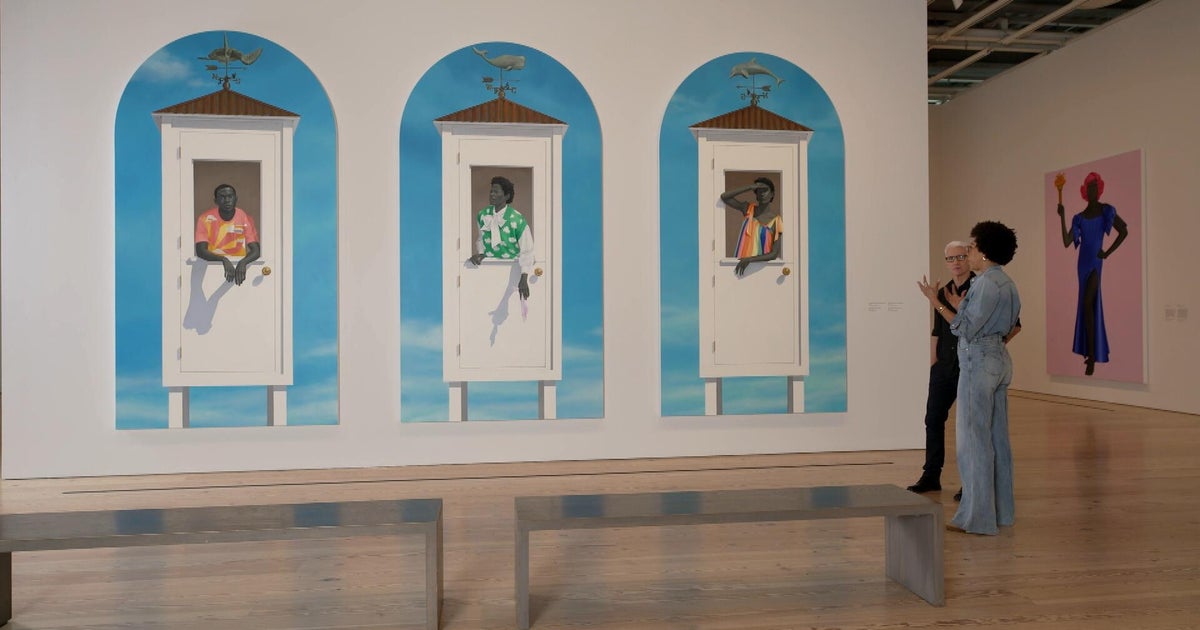
Amy Sherald's Ecclesia is the sky-high finale of her Whitney Museum retrospective, a three-part work the American realist portraitist told CBS News correspondent Anderson Cooper she sees as the show's pinnacle.
CBS News reported that Cooper and Sherald reached the piece last summer while touring Amy Sherald: American Sublime at the Whitney Museum of American Art in New York City. The work's full title is Ecclesia (The Meeting of Inheritance and Horizons).
The artwork consists of three large paintings, each with a curved upper canvas. In each panel, a Black figure in vivid clothing looks outward from a watchtower set against a bright blue sky.
The towers appear suspended without a clear setting, CBS News reported. Sherald told Cooper she does not know whether the figures are above land or water, and she is comfortable leaving that uncertainty in place.
Asked by Cooper whether she knew what one woman in the work was searching for, Sherald said she did not have a fixed answer. She described the moment as spiritual and said she thinks the figure is looking toward the future.
What is Amy Sherald's Ecclesia?
Ecclesia is a triptych, meaning three paintings that operate together as one artwork. CBS News noted that triptychs were first commissioned in the Middle Ages for placement behind church altars.
Sherald told Cooper that a visit to the Uffizi Galleries in Florence helped inspire the work. The museum holds some of art history's best-known examples of the format, according to CBS News.
The watchtower-like structure had another, more cinematic spark. Sherald said it came partly from Wes Anderson's film The Grand Budapest Hotel, specifically a scene in which two characters on the run find a lone telephone booth in a snowy field.
She told Cooper that she paused that frame and recognized something she wanted to use. The result is a formal stage that leaves the figures elevated, exposed and mysterious.
The scale pushed Sherald into new territory. CBS News reported that she needed scaffolding to reach the full surface of the canvases, and Sherald said working on a larger format changed her process.
She recalled painting a face from the scaffold, liking the detail up close, then stepping back and finding the mark had nearly vanished at that size. She told Cooper she had to switch to larger brushes, a departure from her earlier approach.
Sherald said the three paintings took six months to complete. She also told Cooper that Ecclesia was the final work she finished for the exhibition and called it an exclamation point for the show.
For Sherald, the Whitney retrospective appears to close one long chapter. She told Cooper the exhibition gathered about 20 years of ideas from her mind and said that, at 52, she felt she was starting over.
When Cooper asked whether that felt exciting or frightening, Sherald said it was both. She added that she knows who she is as an artist and believes she will be fine.
CBS News said the video segment was produced by Will Croxton and edited by Patrick Lee.
This story draws on original reporting from CBS News.