Berlin Pride attack suspect raised red flags before rampage, group says
A deradicalization group told CBS News it was set to flag Abdul Ballout's cooperation as fake before the deadly Berlin Pride attack.
By Sal Moretti · Money Reporter
3 min read
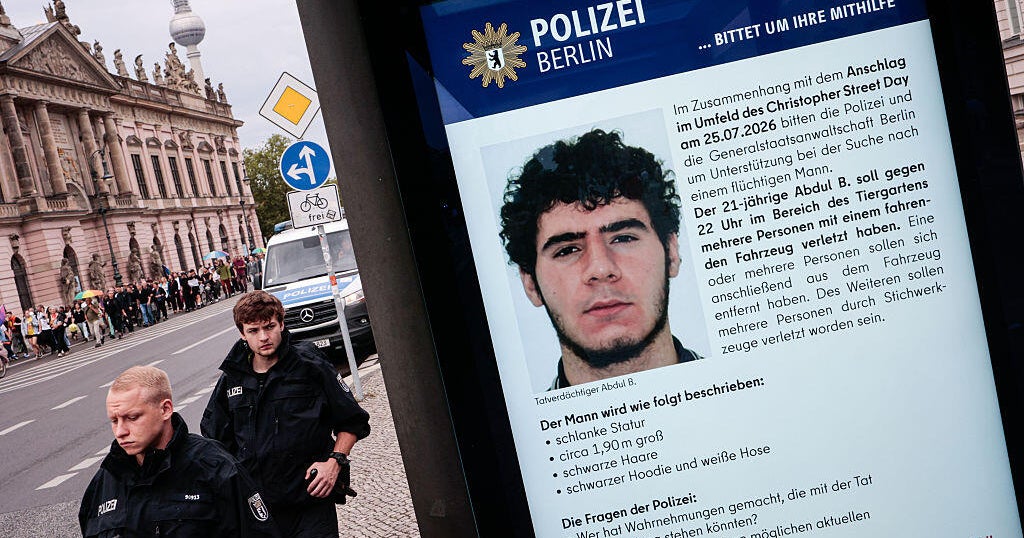
The Berlin Pride attack suspect was close to being rejected by a deradicalization program after staff saw warning signs, a leader at the Berlin-based Violence Prevention Network told CBS News on Monday.
Officials said Abdul Ballout, 21, drove a vehicle into people celebrating one of Europe’s largest Pride events on Saturday night near the Brandenburg Gate, then apparently attacked others with a machete. One woman was killed and at least 29 people were injured.
Ballout, a German-born citizen with Lebanese roots, was shot dead Sunday in a Berlin suburb during a confrontation with police, ending a manhunt that lasted about 24 hours, officials said.
Who was the Berlin Pride attack suspect?
Authorities said Ballout was born in Germany and was known to police before the Pride attack. Berlin prosecutors told CBS News he had previous convictions, including a 2019 schoolyard assault and a 2022 juvenile court conviction for assault and extortion with intent to rob.
Prosecutors said the first signs of Islamist extremism came in 2024, when Ballout posted ISIS propaganda twice on Instagram. The next year, according to the prosecutor’s office, he traveled to Lebanon intending to continue to Syria and join ISIS.
Ballout was arrested and jailed in Lebanon, prosecutors said. After serving his sentence there, he returned to Germany in November 2025 and was arrested at Berlin’s airport.
In May, a juvenile court in Berlin convicted him of preparing a serious act of subversive violence, publishing ISIS propaganda on Instagram and other charges, prosecutors said. He received a sentence of one year and 10 months, but it was suspended, partly because of time already spent in custody and partly because he admitted the crimes and said he had broken with ISIS, according to prosecutors.
What did the deradicalization program say?
After Ballout’s release, a court ordered him to attend a deradicalization program for high-risk offenders. The Violence Prevention Network evaluated him twice, and a third screening had been planned for Monday.
Cornelia Lotthammer, the group’s communications director, told CBS News that staff had a “strong impression” Ballout was too radicalized for the program and had been that way for a long time. She said the organization was preparing to tell authorities that his cooperation appeared fake.
Lotthammer said Ballout gave staff the answers he thought they wanted, but did not seem interested in a real deradicalization process. She also said he showed no sign that an attack was imminent, adding that staff would have contacted police if they had seen an immediate threat.
Lotthammer questioned why officials had not acted sooner, telling CBS News that Ballout had long been known as a radical.
What are German officials saying?
German Chancellor Friedrich Merz told reporters Monday that he wanted answers on how the attack might have been stopped. He said Germany must do everything possible to protect people from dangerous individuals who cannot be taken into custody.
Police said they believe Ballout rented the vehicle used in the attack. Berlin prosecutors also told CBS News that police searched his home in Berlin-Schöneberg on July 3 over an initial suspicion tied to Germany’s Weapons Act, but left after finding only a toy gun. The case was later dismissed.
The Polish foreign ministry in Warsaw said Monday that the woman killed in the attack was a Polish national.
After the violence, mourners gathered at a makeshift memorial by the Brandenburg Gate, leaving flowers, candles, rainbow flags and handmade signs. One mourner told CBS News that people should not be killed over “their choice of love,” while another said anger was natural when someone known to be dangerous was not stopped.
The attack follows other deadly vehicle attacks in Germany, including a December 2024 Christmas market attack in Magdeburg, a February attack on trade union demonstrators in Munich, and a March 2025 ramming in Mannheim. CBS News reported that the attacks had different alleged motives but have kept security, immigration and extremism high in German politics.
This story draws on original reporting from CBS News.