Pepper spray drones head to schools in three states
Schools in Colorado, Florida and Georgia will test Mithril Defense drones meant to confront active shooters within seconds.
By Georgia Hale · Staff Writer
3 min read
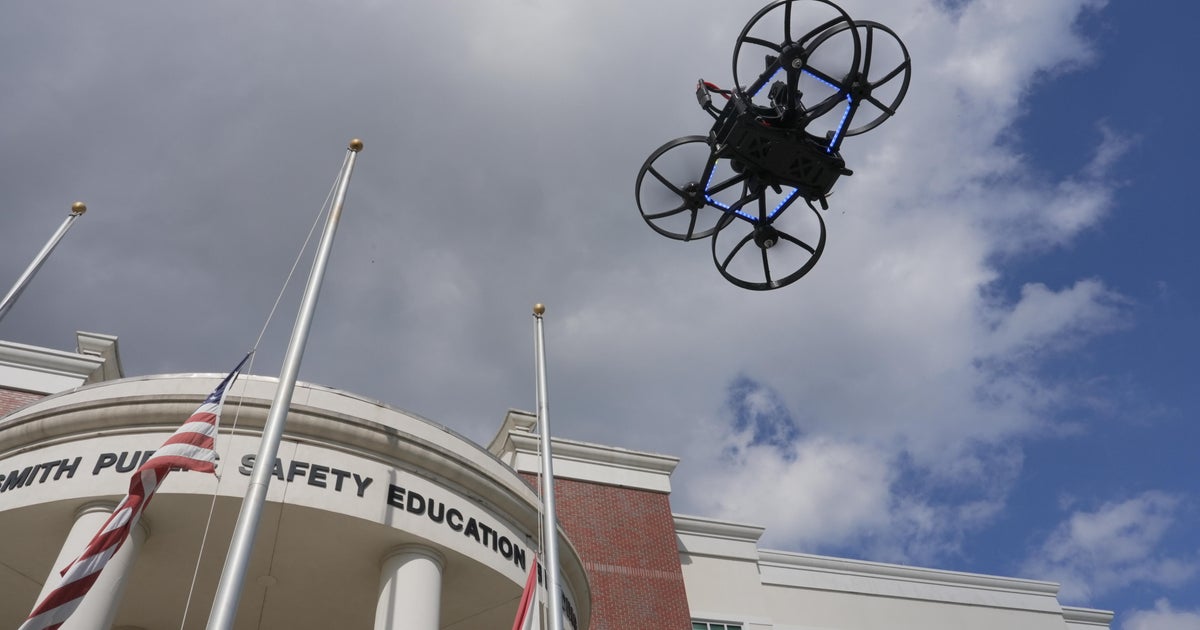
Pepper spray drones are set to become part of school security in Colorado, Florida and Georgia as several campuses start the new academic year with devices built to confront an active shooter within seconds, according to CBS News.
The drones come from Mithril Defense, an Austin, Texas-based company that says its system can work with law enforcement during school shooting emergencies. Chief Executive Justin Marston told CBS News the aircraft can race through hallways at up to 50 miles per hour while remote pilots guide them from the company’s headquarters.
Marston said the goal is to find an active shooter within 15 seconds. The drones are designed to use sirens, strobe lights and pepper gel to disorient an assailant, he said. As a last resort, he added, they can ram a shooter at 60 miles per hour.
How would pepper spray drones work in schools?
Mithril Defense’s drones, called Campus Guardian Angel, are stored in secured boxes inside schools and can be launched within seconds, Marston told CBS News. Remote operators pilot them through the building, and the devices can enter rooms before police officers do.
Marston said speed is central to the pitch because most school shootings end within two to three minutes. He also said drones could reduce risks for police, citing data that officers are shot in about half of mass shootings.
The rollout comes as school safety spending has become a major business across the United States. Schools spend about $4 billion a year on physical security upgrades such as metal detectors and surveillance cameras, according to the Learning Policy Institute.
School shooting incidents reached 352 in 2023 and have declined during the past two years, according to the K-12 School Shooting Database. The database shows annual totals were typically below 30 in the 1970s and 1980s.
What are the safety concerns?
Some school safety researchers argue that technology alone can miss the deeper problem. Jennifer DePaoli, a senior researcher at the Learning Policy Institute, wrote in an April post that research points to the need for students to feel psychologically safe as well as physically protected.
DePaoli said stronger mental health support, trusting relationships between teachers and students, and healthier school environments are among the approaches tied to safer campuses.
Marston told CBS News he supports addressing the causes of school violence, while also arguing that schools need systems ready for an emergency. He compared it with fire safety, saying prevention and response are not mutually exclusive.
Parents in Colorado have also raised direct concerns about whether students could be hurt. Jennifer Iversen told CBS Colorado earlier this month that a drone releasing pepper spray raised ethical and legal questions and called the idea bad.
How much do the school drones cost?
Marston said five Georgia school districts and three Florida districts adopting the drones are being paid for by their states. He put the cost at about $20,000 per year for an 80,000-square-foot school, which he said is less than hiring a security officer.
In Colorado, John Adams Academy, a public charter school, is using private money after the county backed away from providing $200,000 for the program, CBS News reported.
Louisiana is also looking at school drones. The state recently passed a law to fund a drone pilot program in four schools. The Pelican Institute for Public Policy, a Louisiana-focused think tank, said the drones’ selling points include live footage for law enforcement and deterrents such as strobe lights and pepper spray.
Marston told CBS News that demonstrations have helped persuade skeptics, and said Mithril Defense believes active-shooter suppression systems could become a standard expectation for schools in the coming years.
This story draws on original reporting from CBS News.