Spain military heads to Ceuta after Morocco border crossings
Madrid says troops will support police in Ceuta after thousands crossed from Morocco and CBS News reported nine deaths tied to the crisis.
By Georgia Hale · Staff Writer
3 min read
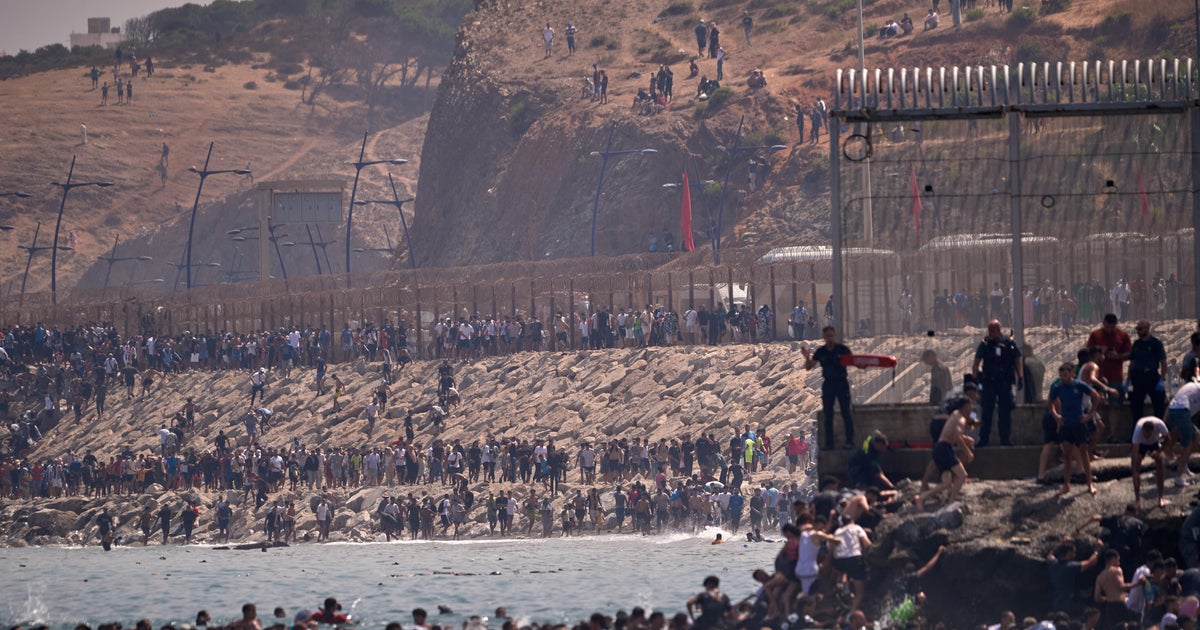
Spain military Ceuta reinforcements are being sent to the border with Morocco after thousands of migrants entered the tiny Spanish territory, prompting Madrid to move troops in to support the Civil Guard, the Spanish government said Thursday.
The deployment follows a request from local officials in Ceuta for help from the central government after large crowds crossed the frontier fence. CBS News reported nine deaths tied to the crisis, while Rachid Sbihi, who heads an association representing Civil Guard officers in Ceuta, and activists in Morocco and Ceuta said at least three people died Wednesday while trying to reach the enclave by sea.
Spain’s government said the Armed Forces would help the Civil Guard “maintain security in the city of Ceuta.” Prime Minister Pedro Sánchez is due to visit the enclave Friday with Interior Minister Fernando Grande-Marlaska, according to the government.
Why is Spain sending the military to Ceuta?
Spain is sending troops because local authorities said the border situation had overwhelmed police capacity after crowds entered from Morocco. The military role announced by Madrid is to support the Civil Guard, the force that polices the border, rather than replace civilian authorities.
Sbihi told The Associated Press that the situation was “absolute chaos” and said exact numbers were impossible to provide, though he described thousands of people crossing and said the border had “totally collapsed.”
Achraf Maimouni, from the Moroccan Association for Human Rights in northern Morocco, called the situation “exceptional.” He said the Tarajal border opened under unusual circumstances Thursday morning and people went through.
Video showed crowds moving around the breakwaters at Tarajal beach and onto local roads, according to the AP. Most appeared to be young men, though families with women and small children were also seen.
Moroccan authorities have not publicly commented on the crossings, and Morocco’s interior ministry did not respond to requests for comment, according to the report.
Spain’s Interior Ministry said Morocco was “closely cooperating” with Spain and that Moroccan police were stopping “numerous people” trying to cross. The ministry said both governments had agreed to work together on the return, as soon as possible, of people who entered Ceuta illegally.
What is Ceuta and why do migrants try to reach it?
Ceuta is a Spanish enclave on the North African coast, bordered by Morocco. Because it is Spanish territory, reaching Ceuta can put migrants inside the European Union’s frontier.
Migrants often try to reach Ceuta by swimming from the Moroccan town of Fnideq, a route of about 3.1 miles, according to the report. Others attempt a shorter crossing from nearby Belyounech.
Spain’s Interior Ministry would not confirm how many migrants had reached Ceuta in recent days and said its next migration report would be published Aug. 3. Ministry figures showed that nearly 3,000 migrants had entered Ceuta by land or sea this year as of July 15.
Ceuta authorities had linked the surge to a Spanish Supreme Court ruling this month that migrants who arrive by sea cannot be immediately returned across the border without due process, unlike people who cross by land, such as over the fence. Some Moroccan activists questioned that explanation, saying many migrants were unlikely to know about the court decision.
Juan Jesús Vivas, the head of Ceuta’s regional government, had asked Madrid to declare an emergency on national security grounds, seeking more police and army deployment at the border. Spain’s Interior Ministry said migration flows are not listed as a national security risk under the law governing emergency declarations.
The scenes revived memories of May 2021, when more than 8,000 migrants entered Ceuta over two days during a diplomatic crisis between Spain and Morocco. Ceuta has been a Spanish possession since 1580 and has a mixed population of Christians and Muslims, Spanish and Moroccan residents, and cross-border workers.
This story draws on original reporting from CBS News.