Trump revives election fraud claims without new proof of vote tampering
The president paired a primetime speech with declassified files, but a White House official said they do not show hacked machines or switched votes.
By Sal Moretti · Money Reporter
4 min read
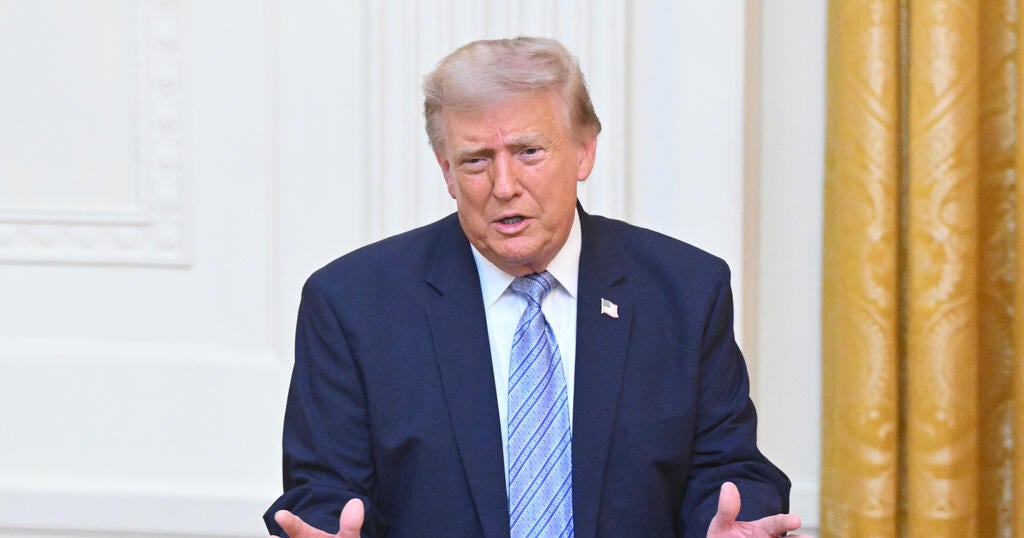
President Trump used a Thursday night primetime address to argue that U.S. elections are badly exposed, while newly released White House documents did not provide evidence that votes were changed or voting machines were hacked.
A White House official told reporters before the speech that the declassified material would not allege vote switching or machine hacking. Trump and his allies have continued to falsely claim that widespread fraud cost him the 2020 election.
The president also pressed Congress to pass the SAVE America Act, a package of election changes that includes requiring proof of citizenship to register to vote. The measure has stalled, with some Senate Republicans wary of it. Republican allies praised Trump’s remarks, while Democrats accused him of trying to damage trust in elections.
David Becker, executive director of the Center for Election Innovation and Research and a CBS News election law contributor, said after the speech that the administration had produced “more rehashed, debunked conspiracy theories” after 18 months in power.
China claim meets a public-records reality check
One of Trump’s sharpest claims was that China obtained 220 million U.S. voter registration files from 2020 to 2023, including names, addresses, phone numbers and party affiliations. He called it the largest election data breach ever and alleged intelligence agencies concealed the information from him and Congress.
Voter registration files are widely available in the United States. Some states publish them online, while others make them available on request, although certain personal details are protected.
Becker said voter files in the U.S. are public, adding that access to those records does not by itself enable election fraud. A 2020 intelligence report declassified years ago found China had obtained voter data from several states for public opinion analysis ahead of the 2020 election.
The U.S. intelligence community assessed in March 2021 that no foreign actor tried to alter ballots, vote counting or voter registrations in the 2020 election. The National Intelligence Council also assessed that China largely stayed out of the race, though one intelligence official held a minority view that China tried to hurt Trump through social media posts and official statements.
The Chinese embassy in Washington told CBS News that China has followed a policy of non-interference in other countries’ internal affairs.
Non-citizen and dead voter claims
Trump cited federal findings that large numbers of non-citizens and dead people are active on voter rolls. He pointed to a Department of Homeland Security review that said more than 250,000 non-citizens were registered across California, Pennsylvania, New Jersey and Nevada.
Becker challenged that finding, saying it relied on commercial data likely to produce many false matches, including eligible voters. Non-citizen voting in federal elections is illegal, and documented cases are rare.
The Brennan Center for Justice reviewed 42 jurisdictions with 23.5 million votes cast in 2016 and found 30 suspected cases of non-citizen voting. State reviews cited by CBS News found small numbers in Georgia, Ohio, Texas and Louisiana compared with each state’s voter rolls.
Cases involving votes cast in the names of dead people have also been uncommon in recent reviews. Georgia officials found four such cases in 2020, Arizona found one, and Michigan lawmakers found two in Wayne County, one of which was a clerical error and one involving a voter who died after mailing her ballot.
Voting machines and audits
Trump also said voting machines and counting systems are vulnerable, and cited intelligence about Venezuela-linked plots involving Smartmatic systems. Smartmatic says its technology is not used in the United States except in Los Angeles County.
Election experts say U.S. voting machines are tightly controlled, generally kept offline and backed by paper records in nearly every state. Becker said machines are secured before public testing, and paper ballots remain available for checks.
In Georgia, every 2020 general election ballot was counted three times: by machine, by a statewide hand audit and again in a Trump-requested machine recount. Each count confirmed Joe Biden’s win in the state.
A January 2020 National Intelligence Council memo cited by Trump said foreign adversaries have the capability to target election infrastructure, including voter databases. The same memo said systems that count or display votes would be difficult to manipulate broadly enough to change results, and warned that false or exaggerated claims could be used to erode public confidence.
This story draws on original reporting from CBS News.