Astronomers spot a space object that does not fit the usual labels
A Jupiter-mass body appears to orbit a brown dwarf 73 light-years away, putting it in a gray zone between planet and moon.
By Poppy Nakagawa · Culture Writer
3 min read
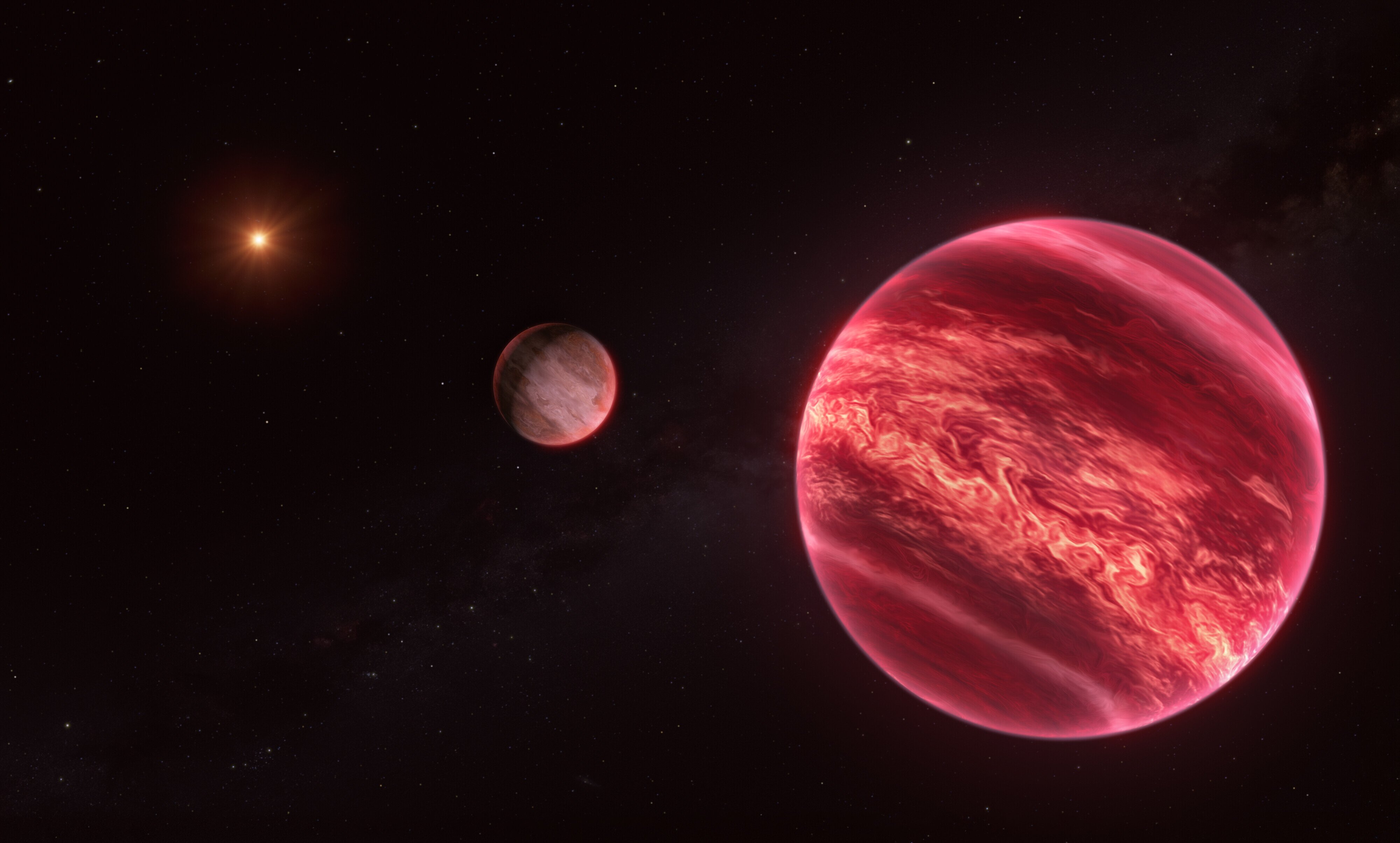
Astronomers have found a possible new kind of cosmic companion in the CD-35 2722 system, about 73 light-years from Earth: an object roughly as heavy as Jupiter that appears to circle a brown dwarf.
The team behind a study published in Nature says the object is awkward to name because the brown dwarf, called CD-35 2722 B, is itself orbiting a star. That makes the newly detected body a satellite of something that sits in the gray area between planet and star.
Brown dwarfs are often described by astronomers as “failed stars” because they are not massive enough to sustain hydrogen fusion in their cores. They are bigger than planets, but smaller than stars.
Kevin Hoy, the study’s lead author, said in a statement from the European Southern Observatory that the team is tempted to call the body a moon because it is the “third wheel” in the system, though it is unlike the small rocky moons familiar in our solar system.
If further observations confirm the finding, the researchers say it could become the first documented exomoon, a moon outside the solar system. For now, the team is using the term “exosatellite.”
A moon, a planet, or something else
The object is far from a typical moon. According to the study team, it is about the mass of Jupiter, while CD-35 2722 B is more than 30 times more massive. At that size, the candidate is likely a gas giant rather than a rocky world.
Hoy said the naming problem cuts both ways. The object is massive enough to be considered a planet, he said, but it does not orbit a star. Instead, it orbits a brown dwarf that orbits a star.
Scientists have found other objects that seem to travel around brown dwarfs before, but the study team says those earlier companions were much farther away from their hosts, making their status as moons or planets open to debate.
This candidate sits much closer to CD-35 2722 B. According to the researchers, it completes an orbit every 170 days.
How the team found it
The researchers did not directly photograph the suspected exosatellite. They used the European Southern Observatory’s Very Large Telescope in Chile to watch CD-35 2722 B move.
Over more than two years, the team collected 23 observations. They found a signal that repeated every 170 days, which they interpret as the brown dwarf wobbling under the gravitational pull of an orbiting object.
That technique, known as radial velocity, is widely used to detect exoplanets. It tracks tiny shifts in an object’s motion caused by the gravity of an unseen companion.
The search for moons beyond the solar system has produced candidates before, but no confirmed discoveries. In 2024, researchers proposed a possible rocky moon around WASP-49 b, about 635 light-years away, based on spectroscopic evidence of a sodium gas cloud that they said could be replenished by volcanic activity from a hidden moon.
In 2018, another team reported evidence of a possible Neptune-size exomoon around Kepler-1625 b using the transit method, which looks for small dips in starlight when objects pass in front of a star.
The CD-35 2722 B candidate still needs more observations before it can receive a confirmed label. Alice Zurlo, an astrophysicist at Universidad Diego Portales in Chile and a co-author of the study, said in the ESO statement that she considers it the first plausible detection of an exosatellite.
This story draws on original reporting from Mashable.