Gene.01 smart skin lets a humanoid robot feel touch
Generative Bionics debuted Gene.01 at AMD’s AI event, showing skin that senses touch, pressure, proximity and temperature for safer robot work.
By Bianca Rossi · Entertainment Editor
2 min read
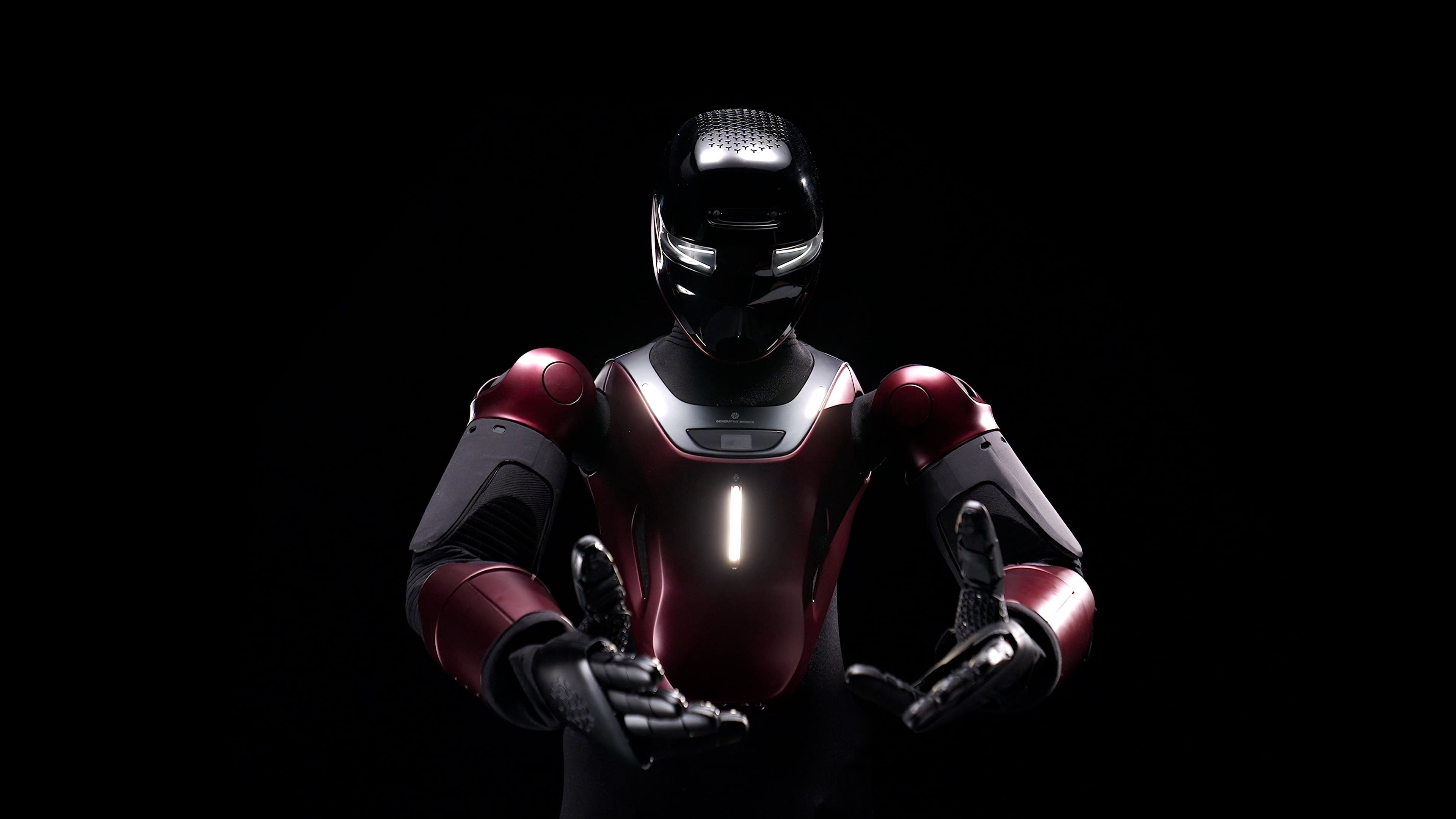
Gene.01 smart skin made its public debut this week, putting a touch-sensitive layer on a humanoid robot that Generative Bionics says is aimed at safer industrial work near people.
The robot, called Gene.01, was shown at AMD’s Advancing AI conference in San Francisco. CNET senior video producer Jesse Orrall had hands-on time with the machine and reported that its skin felt similar to a neoprene wetsuit.
Generative Bionics describes the covering as “full-body multimodal skin” that can detect touch, proximity, force and temperature. In plain terms, the robot is built to know where it is being touched, how hard, and when something is getting close before it makes contact.
What is Gene.01 smart skin?
Gene.01 smart skin is a sensor-covered outer layer for a humanoid robot from Generative Bionics. According to the company and CNET’s reporting, it combines direct-touch sensing with proximity sensing so the robot can register contact and nearby movement around its body.
CNET reported that the touch system uses sensors that can identify contact, pinpoint where pressure is being applied and measure how strong that pressure is. Orrall wrote that when the robot’s arm was squeezed, a live visualization on a nearby screen lit up at the touched spot and became darker as more pressure was applied.
The second part of the system handles nearby objects without requiring direct contact. CNET identified those as time-of-flight sensors, a technology that sends out invisible light and measures how long it takes to bounce back, allowing a device to estimate distance.
In Orrall’s demonstration, waving a hand near the sensors produced dots on a display that moved with the hand. CNET reported that the dots faded as the hand moved farther away.
Why give a humanoid robot touch-sensitive skin?
CNET reported that the practical goal is collision avoidance. If an industrial robot can sense a person or object before a bump happens, or understand contact as it occurs, it could be better suited to work close to humans on factory floors and in similar settings.
Generative Bionics views Gene.01 as an early platform, according to CNET. The company plans to adjust how much smart skin a robot gets, where it is placed and what kind of hands, also known as end effectors, are used for a client’s needs.
The sensing layer is only part of the job. CNET noted that the tougher challenge is getting the robot to respond to that sensor data in real time, and Generative Bionics says that work is still in development.
This story draws on original reporting from Mashable.