Nolan’s The Odyssey nods to myths beyond Homer’s epic
Christopher Nolan’s film pulls in Helen, Clytemnestra, Sinon and a mystery bird, with clues reaching from Homer to Virgil and Aeschylus.
By Poppy Nakagawa · Culture Writer
3 min read
Christopher Nolan’s The Odyssey is built around Odysseus’ punishing trip home from the Trojan War, but the film also flashes toward several myths it does not fully spell out.
Matt Damon plays Odysseus, with Zendaya as Athena, Charlize Theron as Calypso and Bill Irwin as Polyphemus. Around that central journey, the film points to older stories involving Helen, Clytemnestra, Sinon and Circe’s bird-linked family drama.
Helen and Clytemnestra carry the war’s human cost
Lupita Nyong’o appears as both Helen and Clytemnestra, sisters whose stories sit at the center of the Trojan War’s fallout.
Helen is married to King Menelaus of Sparta, played by Jon Bernthal. In the mythic tradition, her abduction by Paris, a Trojan prince and son of King Priam, sets the Trojan War in motion. Christopher Marlowe later gave her the famous tag, “the face that launched a thousand ships.”
Nolan’s film shows Helen back in Sparta beside Menelaus when Telemachus, played by Tom Holland, visits. It also shows her with a scarred face, while leaving unclear who caused the injury.
Clytemnestra’s story is bloodier. In Nolan’s film, she has ruled Mycenae while her husband, King Agamemnon, is away at Troy. Before the voyage, Agamemnon kills their daughter Iphigenia as a sacrifice to Artemis, goddess of the hunt and moon. That episode is not laid out in Homer’s Odyssey, but appears in Aeschylus’ Oresteia.
Agamemnon’s death, however, is part of Homer’s poem. In Hades, the dead king tells Odysseus that Clytemnestra and her lover Aegisthus plotted his murder when he returned from Troy. In Homer’s Odyssey, Clytemnestra also kills Cassandra, the Trojan priestess taken by Agamemnon after the war.
Sinon comes from Virgil, with a Nolan twist
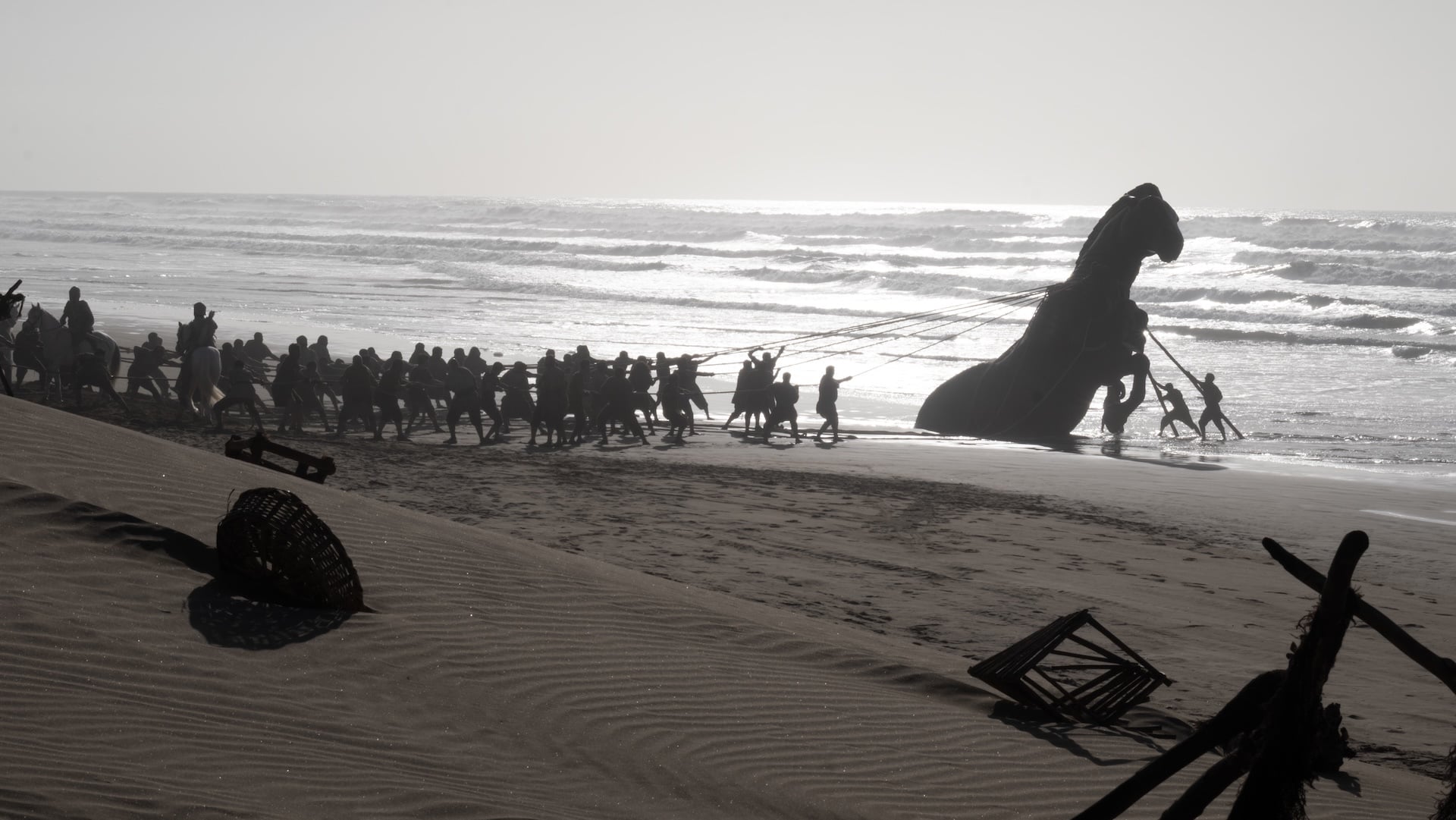
Elliot Page’s Sinon is not drawn from Homer’s Odyssey. The character appears in Virgil’s Aeneid, where he is an Achaean soldier who remains outside Troy and persuades the Trojans to bring the wooden horse inside their walls.
Nolan changes that setup. In the film, Page’s Sinon believes the horse is a sincere offering and does not know Greek soldiers are hidden inside it. In Hades, Sinon confronts Odysseus over the deception after drinking from the blood that lets shades speak.
The film also recasts Sinon as an Ithacan shepherd boy. Antinous, played by Robert Pattinson, pressures him into taking his place in the Trojan War by trading tokens. The link between Sinon and Antinous is not in Homer’s Odyssey or Virgil’s Aeneid.
Circe’s caged raven points to another mystery
Samantha Morton’s Circe transforms Odysseus’ men into pigs in Nolan’s film, matching the sorceress’s famous power over human bodies. The movie also places a caged raven near her and has Circe refer to the bird as her sister.
In Greek mythology, Circe’s sister is Pasiphaë, wife of King Minos and mother of the Minotaur, according to Barry B. Powell’s Classical Myth. That tradition does not include Pasiphaë being turned into a bird.
The bird detail may echo another transformation myth. In Ovid’s Metamorphoses, the sisters Procne and Philomela are changed into birds after taking revenge on Tereus. Nolan’s film uses a raven, while Ovid’s story involves a swallow and a nightingale, so the connection remains only a possible allusion.
The Odyssey is now in cinemas.
This story draws on original reporting from Mashable.