Spain lifts World Cup as Trump’s role shadows U.S. tournament
Rolling Stone’s Jack Crosbie framed the 2026 World Cup as a thrilling tournament caught between soccer joy and U.S. political baggage.
By Poppy Nakagawa · Culture Writer
3 min read
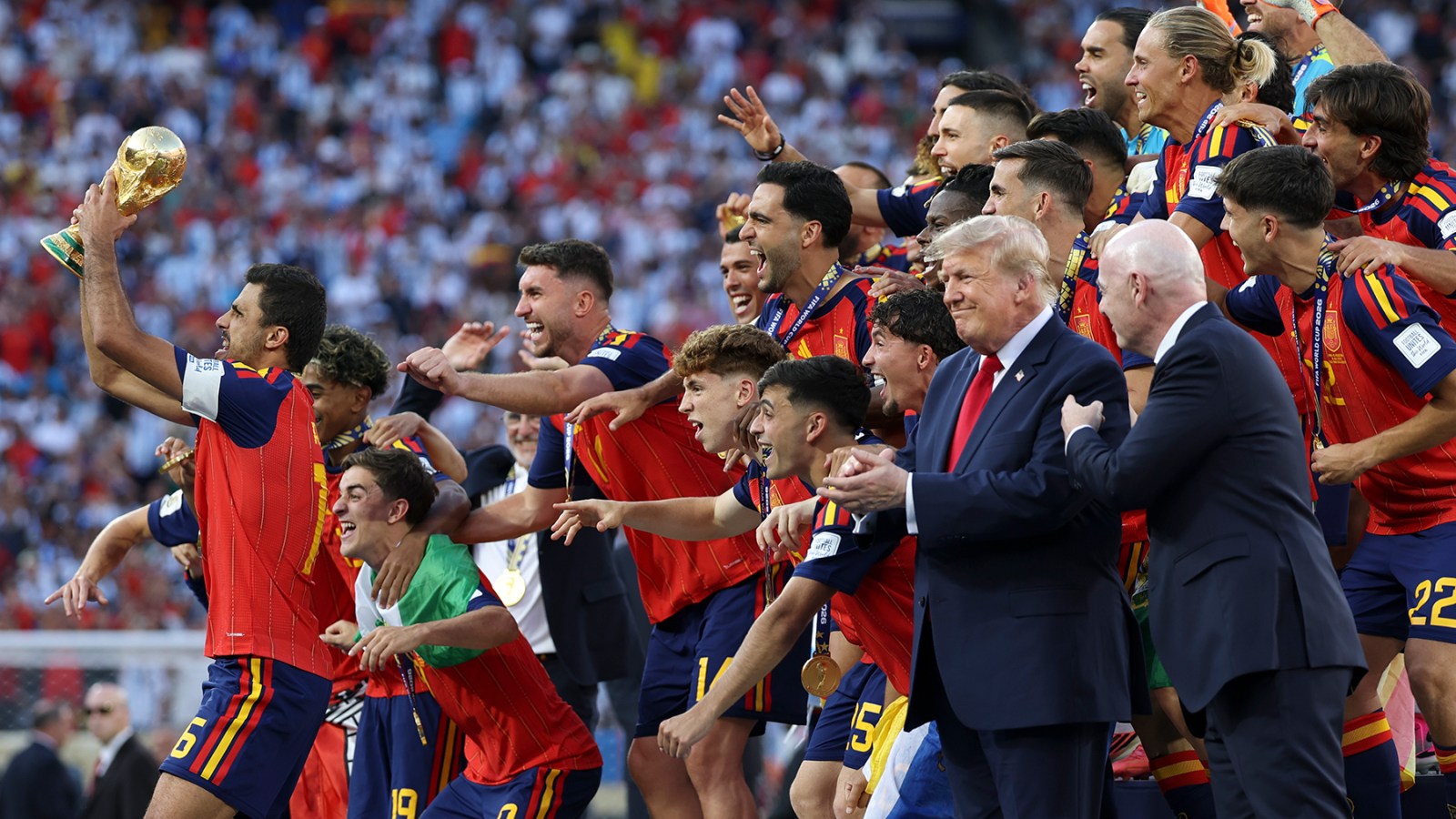
Spain’s World Cup celebration in East Rutherford came with an unmistakable political backdrop: U.S. President Donald Trump and FIFA president Gianni Infantino stood nearby as Rodri lifted the trophy after Spain’s victory over Argentina.
The July 19 final at New York New Jersey Stadium closed a 2026 tournament that Rolling Stone columnist Jack Crosbie described as both a showcase for unforgettable soccer and a mirror of America’s tensions as a host nation.
According to Crosbie, who said he attended the final, Spain controlled play for long stretches against Argentina, but the match remained scoreless until the 106th minute. He credited Argentina goalkeeper Emi Martinez with repeatedly denying Spain before the eventual winners broke through.
Crosbie wrote that Trump went onto the field to present the trophy and stayed onstage as Spain tried to celebrate. Mexican President Claudia Steinbaum and Canadian Prime Minister Mark Carney were also present, according to the column, but Crosbie said the dominant image was Trump beside Infantino during Spain’s moment.
A tournament packed with noise, color and drama
The column cast the broader World Cup as a roaring success on the field and in the stands. Crosbie pointed to Cabo Verde’s run into the first knockout round, saying the team fought back repeatedly before being eliminated late.
He also highlighted attacking performances by France’s Kylian Mbappe, Argentina’s Lionel Messi and Norway’s Erling Haaland. England’s win at Mexico City’s Estadio Azteca also made his list, with Crosbie describing England playing 45 minutes in the rain while down a man before celebrating with fans singing “Wonderwall.”
Off the pitch, Crosbie cited several scenes of fan culture across the host countries. He pointed to reports of Lawrence, Kansas, welcoming Algeria’s national team, Scottish fans drinking through beer supplies in Boston bars, Haitian supporters celebrating their team’s presence at the tournament and Mexico fans partying with South Korean and English supporters.
In Crosbie’s telling, the tournament showed how the World Cup could turn host cities into loud, shared spaces for rival fans, even after painful defeats.
The U.S. team becomes a symbol
The column also used the U.S. men’s national team as a way to discuss identity and politics. Crosbie argued that the squad reflected the country’s promise through players with varied backgrounds, naming Folarin Balogun, Ricardo, Giovanni, Freeman, Zendejas and Haji.
Crosbie wrote that Balogun was born in the United States and connected that fact to birthright citizenship, which he said Trump is trying to eliminate. He also referred to a New York Times Athletic report that Trump intervened after Balogun was suspended for a key match, leading to the player’s reinstatement.
That intervention, Crosbie argued, damaged team chemistry before the U.S. lost to Belgium. He said Christian Pulisic tried to carry too much on his own, Tim Ream struggled physically and a young goalkeeper slipped with little support available.
The column ended on a more hopeful note. Crosbie recalled the U.S. opening match against Paraguay in Los Angeles, where he described a diverse crowd dressed in red, white and blue. The U.S. won that game 4-2, according to the column, and Crosbie argued that supporting the team meant investing in what the country could become.
This story draws on original reporting from Rolling Stone.