Expanded World Cup brings sellouts, stars and controversy to North America
CBS Sports reported that the first 48-team World Cup delivered packed stadiums, new heroes, soaring ticket prices and political flashpoints.
By Georgia Hale · Staff Writer
4 min read
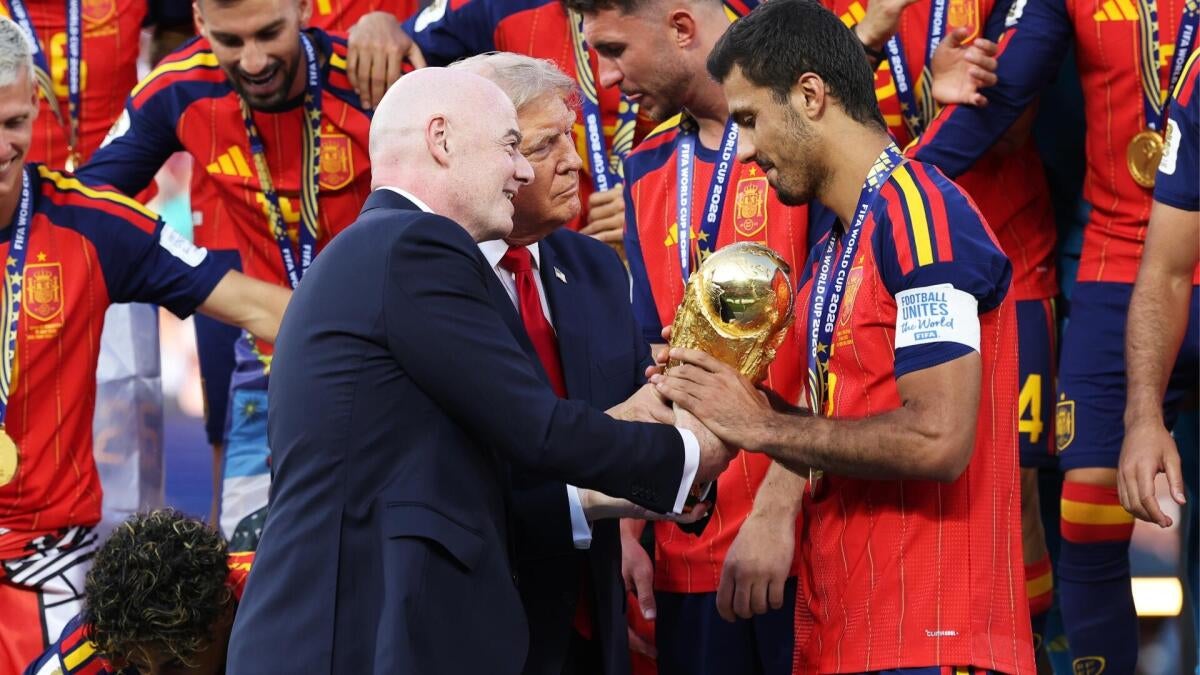
The first 48-team FIFA World Cup turned North America into soccer’s loudest stage for the summer, with CBS Sports describing a tournament that mixed packed stadiums and breakout stories with sky-high prices, mandated stoppages and political controversy.
The competition marked the World Cup’s return to the region 32 years after the 1994 tournament. According to CBS Sports writer Pardeep Cattry, FIFA added fresh layers of showbiz to an event already built on spectacle, from a Fanatics Fest appearance involving Argentina coach Lionel Scaloni and Spain coach Luis de la Fuente to celebrity turns by Kevin Hart, Novak Djokovic and Tom Brady.
Scaloni later called the reunion with de la Fuente, who had been one of his coaching instructors near Madrid years earlier, “a bit of a surreal situation,” CBS Sports reported.
A bigger field brought new faces
The expanded format had some lopsided nights, including Germany’s 7-1 win over Curacao in the island nation’s first World Cup match, according to CBS Sports. Still, the larger field also gave room to teams and players who became part of the tournament’s central story.
DR Congo reached the round of 32 after earlier holding Cristiano Ronaldo’s Portugal to a draw. Brian Cipenga scored against England and helped DR Congo lead the eventual semifinalists for nearly 70 minutes, CBS Sports reported.
Cape Verde also became one of the summer’s standout stories. CBS Sports highlighted goalkeeper Vozinha after Cape Verde played both Spain and Argentina level across 90 minutes.
Vozinha told CBS Mornings that athletes in Cape Verde face steep barriers, including visa issues, limited facilities and fewer chances to be seen by European clubs.
The new format had rough edges. CBS Sports reported that South Korea and Scotland had to wait at their camps for other group results before being eliminated, while Australia’s 0-0 draw with Paraguay flirted with the kind of low-stakes finale critics feared. The round of 32, the report said, sometimes felt like an extension of the group stage.
Fans paid up anyway
Ticket prices were a major theme before the tournament. CBS Sports reported that FIFA more than doubled group-stage prices from the previous men’s World Cup, with some early-round seats costing hundreds of dollars and final tickets reaching into the thousands under dynamic pricing.
The cost did not produce rows of empty seats, according to the report. FIFA’s bet on the U.S. market paid off, even as the Social Security Administration’s 2024 figure put the national average annual salary at just under $70,000.
Some scenes looked unmistakably American. CBS Sports cited Katy Perry’s performance of “Wonder” before the U.S. men’s opener against Paraguay at SoFi Stadium, a celebrity camera shot of Owen Wilson reacting to a Brenden Aaronson miss, Scotland fans taking over Boston and a tournament-wide fascination with cowboy hats and ranch dressing.
The U.S. men’s national team also pulled major attention. More than 50 million people watched the Americans lose 4-1 to Belgium on July 6, CBS Sports reported, calling it an unprecedented figure for the country.
Stoppages and politics left a mark
FIFA’s new presentation choices were not all warmly received. CBS Sports reported that fans regularly objected to mandatory hydration breaks, which became routine every half, and noted that the final included a 30-minute halftime.
De la Fuente said players had been told before the tournament to expect heat, humidity, travel and unusual conditions. He said features that now seem odd, including hydration breaks and longer halftimes, may become normal in 30 years.
The tournament also carried political controversy. CBS Sports reported that Iran had to move its base camp from Tucson, Arizona, to Tijuana, Mexico, after war in Iran that began with joint U.S. and Israeli strikes in late February. The report said travel restrictions affected Iran’s training and recovery before the team exited in the group stage.
Iran coach Amir Ghalenoei said during the group stage that FIFA was trying, adding: “but it doesn’t mean it succeeded,” according to CBS Sports.
CBS Sports also reported that President Donald Trump has claimed he called FIFA president Gianni Infantino to help reverse Folarin Balogun’s suspension before the U.S. match against Belgium. The report said UEFA president Aleksander Ceferin skipped Sunday’s final in protest, particularly over the Balogun decision.
This story draws on original reporting from CBS Sports.