Spain owns both World Cups after another golden summer
Spain now holds the men’s and women’s World Cup titles at the same time, powered by youth success, coaching depth and a shared playing style.
By Georgia Hale · Staff Writer
4 min read
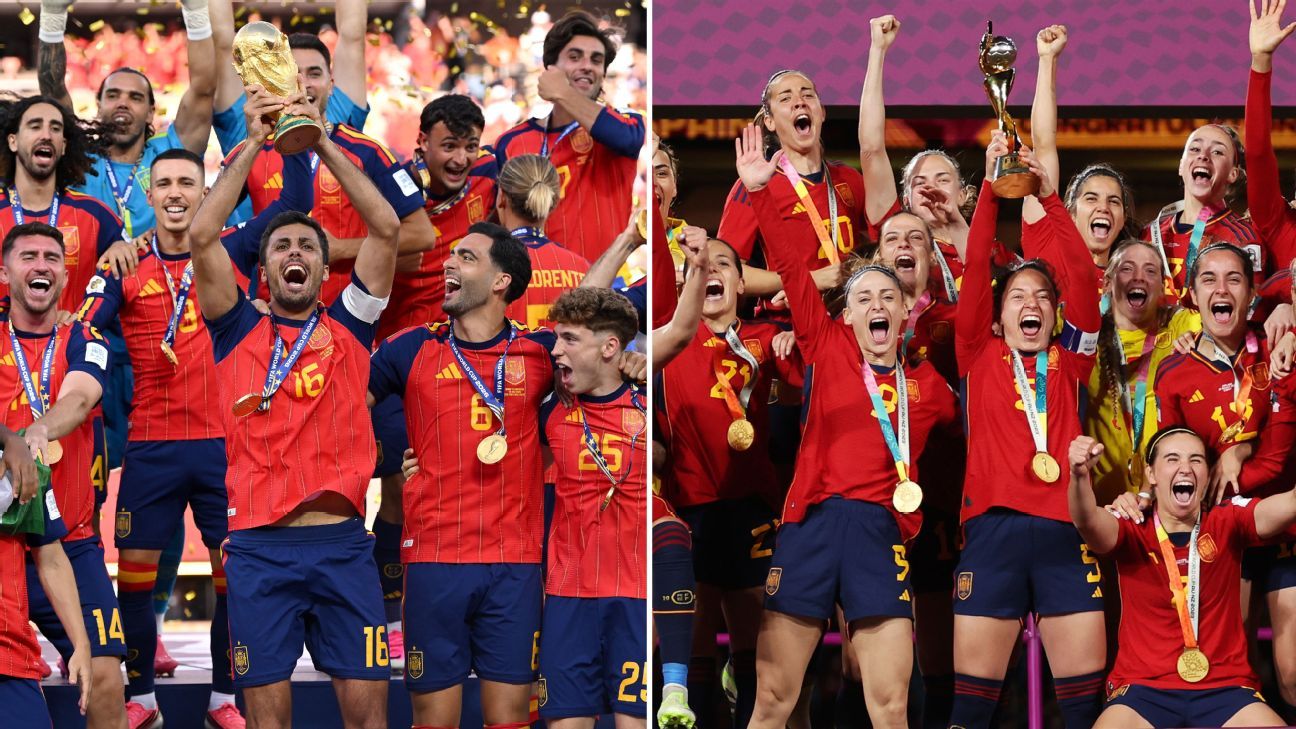
Spain has pulled off a football flex no nation had managed before: according to ESPN, it now holds the men’s and women’s World Cup trophies at the same time.
Ferran Torres scored in the 106th minute against Argentina in Sunday’s men’s FIFA World Cup final in the United States, giving Spain its second men’s world title. That result came three years after Olga Carmona’s goal beat England 1-0 in Sydney to deliver Spain’s first Women’s World Cup.
The senior double capped a busy winning spell. ESPN reported that Spain also won the men’s U19 European Championship in Wales and the women’s U19 European Championship in Bosnia-Herzegovina earlier in July.
Former France star Thierry Henry, speaking on Fox after Sunday’s final, said Spain’s strength is that its teams play with the same ideas across age groups and across the men’s and women’s games. He said that shared identity is why Spain is “dominating world football on every level.”
A system years in the making
Spain’s current run is a long way from its old reputation as a team that often fell short at major tournaments. ESPN noted that before the 2000s, Spain’s only men’s European Championship title had come in 1968.
The change accelerated after Luis Aragonés became men’s coach following Euro 2004. Since then, Spain’s men have won the European Championship in 2008, 2012 and 2024, plus the World Cup in 2010 and 2026. The women’s team added its World Cup in 2023.
The player pipeline is a major part of the story. ESPN reported that Rodri, Unai Simón and Mikel Merino won the U19 European Championship in 2015 under Luis de la Fuente, now Spain’s senior men’s coach. Simón and Merino later won the U21 European Championship in 2019 with Fabián Ruiz, Dani Olmo and Mikel Oyarzabal, again under De la Fuente.
On the women’s side, Ona Batlle, Patri Guijarro and Aitana Bonmatí were part of Spain’s U19 European Championship-winning side in 2017. Sonia Bermúdez, now the women’s senior coach, won that same tournament in 2023 and 2024 with younger players expected to push toward the senior team.
Youth trophies and coaching muscle
Spain’s youth record is doing plenty of shouting. ESPN reported that the men’s U19 team won all five games at this year’s European Championship, scored 19 goals and conceded none. Spain has now won that competition 13 times.
The women’s U19 team has won its European Championship eight times, including the last five editions dating back to 2022, according to ESPN.
The coaching base is another edge. UEFA’s last official breakdown, cited by ESPN from 2013, listed Spain with 15,423 UEFA A and Pro-licensed coaches, ahead of Germany with 6,937, France with 3,308, Italy with 2,281 and England with 1,395.
That Spanish coaching reach is visible across club football. ESPN listed Mikel Arteta at Arsenal, Unai Emery at Aston Villa, Xabi Alonso at Chelsea and Andoni Iraola at Liverpool among Spanish coaches in the Premier League, while Pep Guardiola had left Manchester City after winning six titles in 10 years.
Barça roots, national reach
Barcelona’s La Masia academy remains central to the story. ESPN pointed to Carles Puyol, Gerard Piqué, Jordi Alba, Xavi Hernández, Andrés Iniesta and Pedro as key figures in Spain’s earlier golden era.
This summer’s Spain men’s squad included eight Barcelona players, according to ESPN, while Alejandro Grimaldo, Marc Cucurella and Víctor Muñoz had also spent time at La Masia. Torres, a Barcelona forward, scored the final winner, and Pau Cubarsí was named Young Player of the Tournament.
Barcelona’s influence on the women’s team is even stronger, with ESPN naming players including Cata Coll, Batlle, Irene Paredes, Mapi León, Guijarro, Bonmatí, Alexia Putellas, Vicky López, Salma Paralluelo and Mariona Caldentey as Barcelona players or former Barcelona players.
ESPN also stressed that Spain’s model is broader than one club, citing Real Betis, Villarreal, Athletic Club and Real Sociedad as academies that develop talent.
After Sunday’s win, De la Fuente said he was proud of a generation that had grown with Spain’s football philosophy, stayed loyal to it and improved it. On current evidence, the rest of the world is still trying to catch up.
This story draws on original reporting from ESPN.com.