Spain World Cup win came from midfield muscle, ESPN analysis says
Spain won the World Cup without a Golden Boot threat, with ESPN pointing to Rodri and a midfield built to control slower games.
By Deshawn Carter · Sports Writer
3 min read
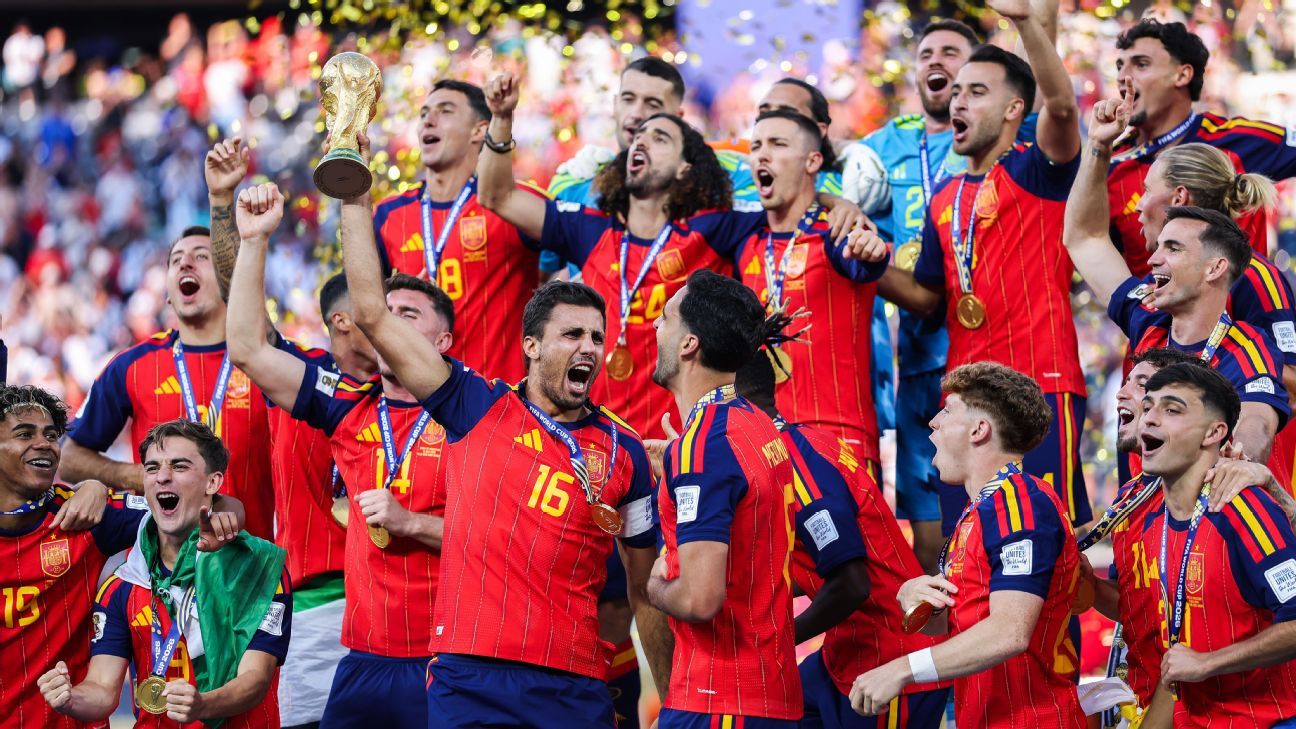
Spain’s World Cup win did not follow the usual superstar script: no dominant Golden Boot contender, no Lionel Messi-style centerpiece, and no defense described by ESPN as elite across the board.
According to an analysis by ESPN’s Ryan O’Hanlon, Spain instead won the tournament by owning the middle of the pitch. O’Hanlon argued that Spain had the best team at the World Cup because its midfield controlled matches in an era when international soccer has slowed down.
The case was not built only on vibes. ESPN cited Elo ratings, a system that scores national teams across international matches, and said Spain are now the highest-rated side in that system’s history. O’Hanlon also noted Spain have not lost since March 2024, calling it the longest unbeaten run in men’s international soccer history.
How did Spain win the World Cup?
ESPN’s answer was blunt: Spain’s midfield was the tournament’s difference-maker. Rodri, named the Golden Ball winner, became the symbol of what O’Hanlon called the “Rodri Theory,” the idea that the team with the strongest midfield wins the modern World Cup.
Spain’s path backed up the point. ESPN wrote that France arrived in the semifinals as World Cup favorites and had elite attacking talent, including Kylian Mbappé, but Spain held them to 10 shots, no high-quality chances and no goals. In the final, O’Hanlon said Spain squeezed Argentina and Messi out of the match to take the title.
That was striking because Spain’s squad did not read like a fantasy XI at every position. ESPN described fullbacks Pedro Porro and Marc Cucurella as coming off average-ish Premier League seasons with Tottenham and Chelsea. Aymeric Laporte had moved to the Saudi Pro League, while Pau Cubarsí, despite being named young player of the tournament, was framed as still early in his rise at Barcelona.
The attack was not packed with tournament-leading scorers either. ESPN noted Álex Baena had spent much of the previous season as a substitute for Atlético Madrid, while Mikel Oyarzabal had not hit double-digit non-penalty goals in a LaLiga season for eight years. Lamine Yamal was already a star, but ESPN said he finished the World Cup with one goal and no assists.
Why midfield matters more at the World Cup
O’Hanlon’s analysis pointed to pace. ESPN said the average possession at this World Cup lasted 28.1 seconds, which was 2.5 seconds longer than in the most recent Premier League season. Slower possessions bring midfielders into more of the action at both ends, giving them more influence than they may have in faster club matches.
Elo ratings are a historical ranking model that adds or subtracts points from teams based on match results. In soccer, they are often used to compare national teams across eras because they stretch back through international football history.
ESPN also placed Spain in a longer pattern. O’Hanlon wrote that every men’s World Cup winner since 2006 has had an exceptional midfield: Italy with Andrea Pirlo, Gennaro Gattuso and Francesco Totti; Spain in 2010 with Sergio Busquets, Xavi, Andrés Iniesta and Xabi Alonso; Germany in 2014 with Toni Kroos, Bastian Schweinsteiger and Philipp Lahm; France in 2018 with N’Golo Kanté, Paul Pogba and Antoine Griezmann; and Argentina in 2022 with Alexis Mac Allister, Enzo Fernández and Rodrigo De Paul supporting Messi.
Spain’s title, in that reading, was no mystery. It was another World Cup claimed in the engine room.
This story draws on original reporting from ESPN.com.