SpaceX Starship test flight reaches Indian Ocean after hard booster splashdown
SpaceX’s 13th Starship test sent satellites overboard, restarted an engine in space and ended with an intact splashdown near Australia.
By Georgia Hale · Staff Writer
3 min read
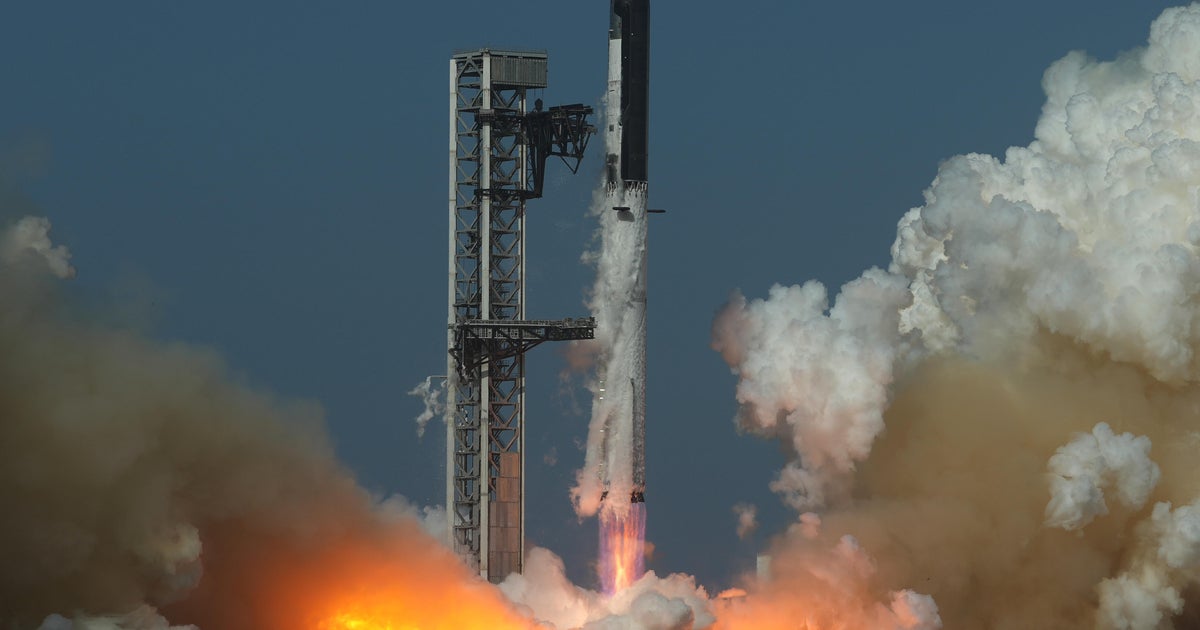
SpaceX’s latest SpaceX Starship test flight got off the pad in Texas and made it all the way to the Indian Ocean, giving the company a cleaner run for the upper stage even as the giant booster came down harder than planned in the Gulf of Mexico.
The 397-foot Super Heavy-Starship lifted off from SpaceX’s Starbase site on the Texas coast at 5:51 p.m. EDT Friday, according to CBS News. SpaceX said the rocket’s first stage used 33 methane-fueled Raptor engines, producing about 16 million pounds of thrust as it climbed away.
The launch followed a scrubbed July 16 try, when a computer stopped the countdown after four Raptor engines failed to start properly, CBS News reported. A later attempt was pushed back 24 hours because of low clouds.
What happened on the SpaceX Starship test flight?
SpaceX’s Super Heavy booster separated from the Starship upper stage, flipped for its tail-first descent and aimed for a splashdown off the Texas Gulf Coast. CBS News reported that fewer engines appeared to restart than planned during the final drop, leading to what was described as a hard splashdown at a higher speed than expected.
SpaceX has designed the booster to return to its launch tower, where large mechanical arms known as “chopsticks” are meant to catch it. For early flights of this third-generation vehicle, however, the company is using Gulf splashdowns as a safety measure, CBS News reported.
The Starship upper stage had the stronger day. SpaceX video and flight data showed its six Raptor engines running during ascent, and the vehicle then coasted on a sub-orbital path toward the Indian Ocean.
During the flight, Starship released 20 third-generation Starlink internet satellites through a slot near its nose, according to SpaceX coverage cited by CBS News. Six of those satellites carried cameras intended to inspect Starship’s heat shield tiles and general condition, a test meant to help engineers judge whether similar video could check future vehicles before re-entry.
Starship also briefly restarted one Raptor engine in space. CBS News reported that such restarts will be needed for future moon flights.
The upper stage then endured belly-first re-entry heating, flipped upright and made a rocket-powered splashdown northwest of Australia one hour and five minutes after launch. CBS News reported that, for the first time, Starship remained intact after splashdown, with many onboard cameras still working.
Why does this flight matter to NASA?
NASA is counting on a version of Starship to land Artemis astronauts on the moon. For those missions, SpaceX must launch a series of Super Heavy-Starship tankers to refuel the lunar lander before it heads to lunar orbit, CBS News reported.
The planned Starship moon lander would carry two astronauts from a Lockheed Martin-built Orion capsule down to the lunar surface near the moon’s south pole. The crew would use an external elevator to reach the surface and return to the lander, according to the mission plan described by CBS News.
NASA’s first such landing is targeted for 2028, but the Government Accountability Office warned Thursday that SpaceX still faces major hurdles. In its report, the GAO said SpaceX’s work on cryogenic fuel management is “a top risk” because the moon plan requires propellant transfers between multiple Starships in low-Earth orbit.
The GAO also said SpaceX is more than a year behind its original timetable for key steps, including critical design review, long-duration and propellant-transfer demonstrations, and an uncrewed lunar landing test.
NASA also has Blue Origin developing lunar landers for cargo and Artemis crews, CBS News reported. Blue Origin’s lander, which would launch on New Glenn, also requires refueling in space.
This story draws on original reporting from CBS News.