Venezuela earthquake recovery leaves families searching three months later
Three months after the June 24 earthquakes, a La Guaira man is still seeking his mother and cousin beneath a dangerously collapsed building.
By Sal Moretti · Money Reporter
3 min read
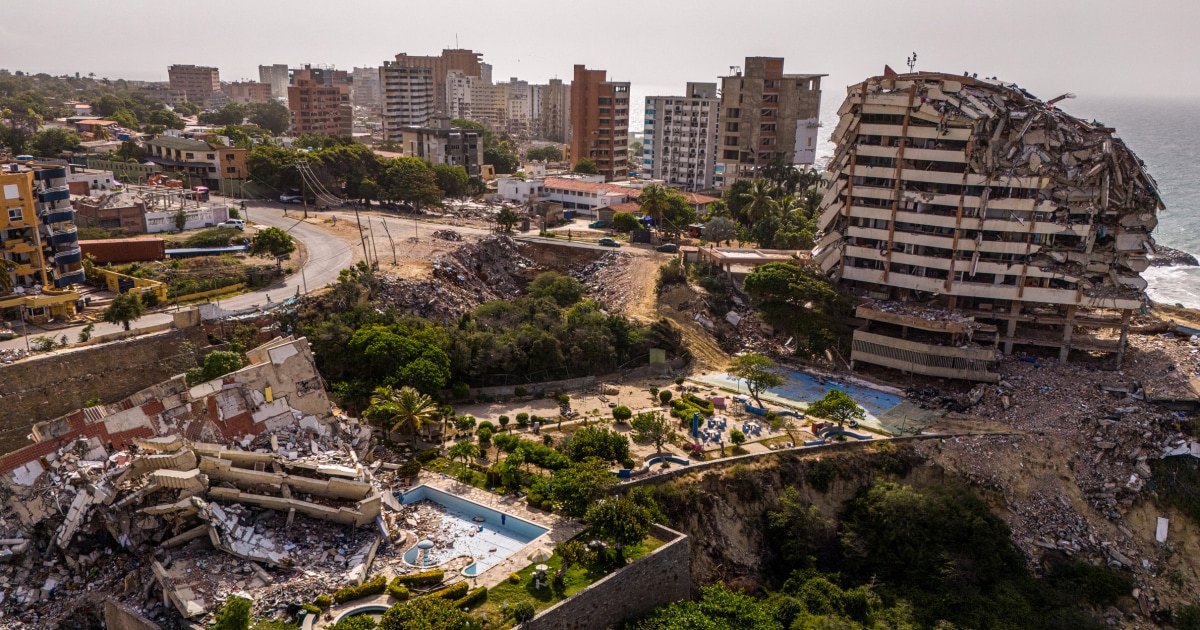
Venezuela earthquake recovery efforts were still leaving families without answers three months after the June 24 quakes, with one man in La Guaira keeping watch beside the ruins where his mother and cousin are believed to be buried.
NBC News reported on Sept. 28 that Cristian Verdú, 23, lost his brother, mother and cousin in the earthquakes that struck the Venezuelan coast in quick succession. His mother and cousin had not been recovered from the Jurel building in Playa Grande, the report said.
A drone search located the pair and other victims in the rubble, according to NBC News. That is not the same as a recovery or formal identification, and no official record of either was included in the report.
Why are some remains still unrecovered after the Venezuela earthquakes?
The condition of the Jurel has made recovery exceptionally dangerous. NBC News described it as a 12-story building in which the lower floors partly held while upper levels fell successively onto them.
Verdú’s mother had been on the eighth floor and ended up on the sixth, NBC News reported. A Mexican rescue team tried to reach her but halted because the site posed too great a risk of another collapse.
Verdú, who survived because he was in Naiguatá when the earthquakes struck, set up a tent near the building to follow the search for his mother. NBC News reported that his plea for help drew wider attention after journalist Maryorin Méndez posted a video of him asking for assistance.
La Guaira faced a difficult recovery from the start
La Guaira, on Venezuela’s northern coast, was the state hardest hit by the magnitude 7.2 and 7.5 earthquakes, according to an Associated Press report published by PBS on July 3.
At that point, AP reported at least 2,295 deaths and thousands of people missing. Officials were struggling to collect, identify and preserve bodies for families, the report said, while a forensic technician estimated that relatives or neighbors could identify bodies in about 60% to 70% of cases, often through tattoos, scars or clothing.
Private companies donated cooling containers at La Guaira’s seaport to help preserve remains, AP reported. The technician said then that collecting bodies could take up to three months.
Other reporting from the first weeks documented residents entering unstable debris to look for relatives. France 24 reported on July 16 that people at collapsed social-housing towers were digging narrow tunnels through rubble and called themselves “the moles”; the report said searches had shifted from survivors to bodies.
For Verdú, the three-month mark has brought no known recovery of the relatives located under the Jurel. The barrier remains the same one rescuers confronted early on: getting into the crushed building without bringing more of it down, according to NBC News.
This story draws on original reporting from NBC News.